Industrial pallet racking systems shape how warehouses store, move, and protect goods across global supply chains. For buyers, the right Industrial Pallet Racking System must match product weight, pallet dimensions, aisle width, and handling equipment. It should also reflect local building conditions, fire protection requirements, and installation practices. A strong specification begins with real warehouse measurements, not a generic online image. Small details matter. Upright frames, beams, guards, anchors, and decking must work together under daily loading pressure.
Experienced warehouse planners review load tables, pallet movement, impact risks, and future expansion before approving a design. They verify steel quality, coating performance, weld consistency, and traceable inspection records. Reliable suppliers explain their testing methods and provide clear documentation. Independent engineering review may be appropriate for high-bay, seismic, or heavily automated facilities. Still, no supplier can remove every operational risk. A catalog rating alone is not enough. Site teams need training, routine inspections, and a process for reporting damaged components. That reality is easy to overlook.
Global buyers also compare lead times, replacement parts, communication quality, and after-sales support. A lower purchase price may become expensive when beams arrive late or installation guidance is unclear. Buyers should request drawings, sample calculations, warranty terms, and maintenance recommendations. They should question assumptions. The best solution balances capacity, safety, accessibility, and long-term value. It may not be the most dramatic option. It should be the one that performs predictably when the warehouse is busy, crowded, and changing.
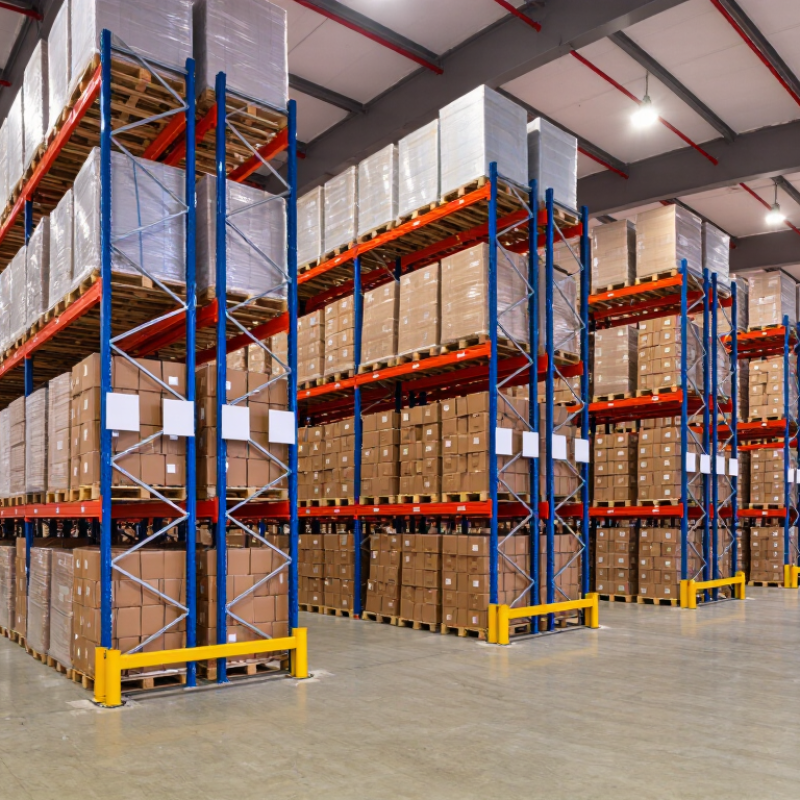
An industrial pallet racking system is a steel storage structure for organized, high-density pallet handling. It uses upright frames, horizontal beams, connectors, and often wire decking. Anchors, aisle markings, column guards, and load signs complete the installation. Forklifts place pallets into elevated positions, while operators retrieve them from designated levels.
The system is more than shelving. Its design connects pallet dimensions, load weight, ceiling height, forklift reach, aisle width, and warehouse movement. Selective racking offers direct access to every pallet. Drive-in layouts improve density but reduce individual access. In practical warehouse assessments, small measurement errors can create blocked aisles or unsafe beam loading. That part is often underestimated.
MHI’s 2024 Annual Industry Report found that 55% of supply chain leaders planned to increase technology investment. This supports smarter rack planning, including inventory data, sensors, and warehouse software. Yet technology cannot repair weak foundations or poor loading discipline. The Rack Manufacturers Institute’s 2024 specification emphasizes engineered rack design, testing, installation, and inspection. Local building and workplace-safety rules still apply. A credible supplier should provide load calculations, drawings, inspection guidance, and clear installation records.
The system may look simple. It is not. Periodic inspections should check bent uprights, damaged beams, missing pins, loose anchors, and overloaded levels. Even the best design needs disciplined daily use.
An industrial pallet racking system works through a simple load path. Pallets rest on horizontal beams, while upright frames transfer weight into the floor. Bracing keeps the structure stable during forklift movements and uneven loading. Each bay must match pallet dimensions, product weight, forklift reach, and required aisle clearance.
The operating method is selective storage. A forklift places pallets into open beam levels and retrieves them directly. This provides fast access, but it uses more floor space than dense systems. MHI’s 2024 Annual Industry Report found that 55% of supply chain professionals planned to increase technology investment. That shift makes barcode scanning, warehouse software, and rack inspections more connected. However, digital control cannot correct a poorly anchored frame.
Safety depends on details. Operators should verify beam locks, upright damage, floor conditions, and posted load limits. OSHA guidance emphasizes protecting racks from vehicle impact and maintaining safe work areas. DHL’s 2024 Trend Radar maps 40 logistics trends, including robotics and smart operations. These tools can improve accuracy, yet automation may introduce new collision points. A practical design should include guards, clear travel paths, and visible capacity labels. Small mistakes matter. A bent upright may look harmless during a busy shift. It is not. Perfect layouts rarely survive real operations, so periodic review should consider changing pallets, forklifts, and worker behavior.
Reference comparison of common industrial pallet-racking configurations, operating characteristics, and planning parameters.
| System Type | How It Works | Typical Pallet Access | Typical Clear Aisle Width | Typical Storage Density | Best-Fit Applications |
|---|---|---|---|---|---|
| Selective Pallet Racking | Upright frames and horizontal beams create individual pallet locations. A forklift loads and retrieves pallets directly from the front of each rack bay. | Direct access to every pallet location | Approximately 3.0–3.7 m for conventional counterbalance forklifts | Low to medium; usually about 90–95% selectivity of stored pallets | Warehouses with many stock-keeping units, mixed inventory, and frequent pallet access |
| Very Narrow Aisle (VNA) Racking | High rack structures are arranged in narrow aisles. Specialized turret or articulated forklifts operate within the aisle to place and retrieve pallets. | Direct access to every pallet location | Approximately 1.5–1.8 m, depending on truck design and load dimensions | High; more storage positions per square metre than conventional selective layouts | Facilities that need high vertical utilization while retaining full pallet selectivity |
| Double-Deep Racking | Two pallet positions are stored one behind the other. A reach truck with an extended mechanism accesses the rear position through the front position. | Direct access to the front pallet; rear pallet access requires front-position movement | Approximately 3.0–3.5 m, depending on equipment and layout | Medium to high; typically increases pallet density compared with single-depth selective racks | Operations with several pallets per stock-keeping unit and moderate retrieval frequency |
| Drive-In Racking | Forklifts enter rack tunnels supported by rails. Pallets are stored in depth, with the last pallet loaded generally retrieved first. | Limited; commonly operates on a last-in, first-out basis | Usually about 3.0–3.5 m for the operating aisle, excluding rack tunnels | Very high; minimizes the number of access aisles | Large quantities of uniform products with low product variety and low rotation frequency |
| Drive-Through Racking | Forklifts can enter from both sides of the rack structure. Loading and unloading can be organized from opposite faces. | Limited to moderate; supports first-in, first-out when loading and unloading are controlled from opposite sides | Usually about 3.0–3.5 m on each operating side | Very high; uses deep storage lanes with fewer aisles | Uniform products requiring higher throughput or first-in, first-out inventory rotation |
| Pallet Flow Racking | Pallets are loaded from the replenishment side and move on inclined roller beds toward the picking side under gravity or controlled braking. | Front pallet access with automatic stock rotation | Typically about 3.0–3.7 m for forklift aisles | High; storage lanes are deep and use a separate loading and picking face | Perishable goods, date-sensitive inventory, and high-volume first-in, first-out operations |
| Push-Back Racking | Each lane stores multiple pallets on nested carts or inclined rails. Loading a new pallet pushes previously stored pallets deeper into the lane. | Front access; generally last-in, first-out | Typically about 3.0–3.5 m for forklift operation | High; multiple pallet positions are stored in each lane without forklift entry | High-density storage where several pallets of the same product are held together |
| Mobile Pallet Racking | Rack rows are installed on powered or mechanically assisted mobile bases. Rows move to open one working aisle when access is required. | Direct access to stored pallets, with one or a limited number of open aisles | One operating aisle is typically opened; aisle width commonly remains about 3.0–3.7 m | Very high; reduces fixed aisle space while preserving selective access | Cold stores, archives, and facilities where floor space is expensive or limited |
| Automated Pallet Storage and Retrieval | Stacker cranes, shuttle vehicles, or other automated equipment transport pallets between rack locations and conveyor or workstation interfaces. | System-controlled access to each assigned pallet location | Equipment-specific; rack aisles can be narrower than conventional forklift aisles | High to very high; supports dense vertical storage and continuous operation | High-throughput distribution, controlled environments, and operations requiring accurate inventory tracking |
| Planning Dimension | Common Industrial Range or Requirement | Why It Matters |
|---|---|---|
| Pallet Load | Common warehouse pallet loads range from approximately 500 to 1,500 kg; heavy-duty systems may be designed for 2,000 kg or more per pallet position. | Beam capacity, upright capacity, slab loading, and handling-equipment selection must be based on the actual unit load. |
| Rack Height | Many forklift-served installations are approximately 3–12 m high. Higher systems require specialized equipment, building clearance, and additional engineering review. | Height affects storage capacity, equipment reach, sprinkler clearance, seismic design, and installation requirements. |
| Beam Levels | Typical installations use 2–6 beam levels above the floor, although the exact number depends on ceiling height, pallet dimensions, and required clearances. | More levels increase capacity but require adequate vertical clearance for safe pallet placement and retrieval. |
| Pallet Clearance | A practical vertical clearance is often about 75–150 mm above the load, subject to pallet height, beam profile, forklift tolerances, and local design rules. | Insufficient clearance can cause pallet impact, unstable handling, and damage to rack components or goods. |
| Pallet Orientation | Most systems use pallets placed with the longer or shorter side facing the aisle according to the rack beam arrangement and pallet-support requirements. | Orientation determines bay width, beam length, supported span, storage density, and forklift access. |
| Rack Protection | Common protective measures include upright guards, end-of-aisle barriers, column protection, guide rails, and impact-resistant bollards. | Protection reduces the risk of damage from forklifts and helps preserve the structural integrity of the rack system. |
| Load Signage | Rack locations should display clearly visible load notices stating permissible beam, bay, or pallet-position capacities. | Visible capacity information helps operators avoid overloading and supports warehouse safety inspections. |
| Inspection and Maintenance | Racking should receive routine visual checks by trained personnel and formal inspections at intervals determined by the site risk assessment and applicable regulations. | Early identification of bent uprights, damaged beams, missing locking pins, and overloaded locations helps prevent failures. |
Selecting the right pallet racking system begins with warehouse behavior, not product appearance. Selective pallet racking suits mixed stock and frequent access, with clear visibility for forklifts. It uses more aisles, but supports accurate picking and easier inventory checks. Drive-in racking stores large quantities of similar pallets and reduces aisle space. It works well for stable, low-rotation goods. However, deeper lanes can hide damaged pallets or older inventory.
Push-back racking improves storage density while allowing several pallet positions per lane. It fits warehouses handling multiple product groups with moderate rotation. For strict first-in, first-out control, pallet flow racking uses rollers and gravity to move loads forward. It is useful for food, beverage, and temperature-sensitive operations.
Double-deep racking adds density, but requires suitable forklifts and stronger location discipline. Small errors become expensive. Long materials need cantilever racking, with adjustable arms for pipes, panels, or timber. Carton flow systems support manual picking where workers need items presented at the front.
In practice, a layout rarely performs exactly as planned. Forklift turning space may feel adequate on paper, yet become tight during peak shifts. Rack height, floor condition, load weight, fire protection, and local safety requirements must be checked together. Experienced engineers should verify beam capacity, anchoring, impact protection, and inspection routines before installation.
Top Industrial Pallet Racking System for Global Buyers
Load capacity starts with real operating conditions, not a catalog number. Record pallet weight, dimensions, beam levels, forklift type, and floor condition. A 2,000-kilogram pallet needs more than a 2,000-kilogram beam rating. Dynamic impacts and uneven loading require safety margins. ANSI MH16.1, referenced by the Rack Manufacturers Institute, supports engineering checks for rack design and stability.
Quality appears in steel thickness, weld consistency, upright protection, and traceable inspection records. Ask for material certificates, design calculations, and tested connection details. EN 15635 requires regular rack inspections and immediate action for serious damage. Small bends matter. A damaged upright can reduce structural performance before failure looks obvious.
Safety also depends on people and maintenance. OSHA estimates that forklifts cause about 85 workplace deaths and 34,900 serious injuries annually in the United States. That figure should influence aisle planning, guarding, training, and pedestrian separation. Never treat posted capacity as permanent. It changes after impacts, layout changes, or unapproved alterations. One practical weakness remains: buyers often compare steel prices before reviewing engineering documents. That approach saves money briefly, but creates costly uncertainty later.
Typical safe working loads for selective pallet racking vary by beam length and configuration. Longer beams generally carry less load, while shorter beams can support higher loads. Buyers should verify the manufacturer's certified load tables, upright capacity, beam deflection limits, anchoring requirements, and local safety standards before installation.
Top Industrial Pallet Racking System for Global Buyers
Selecting pallet racking begins with warehouse facts, not catalogue images. Measure clear height, aisle width, slab condition, pallet dimensions, and daily stock movement. The 2023 World Bank Logistics Performance Index evaluated 139 economies, showing that delivery reliability varies widely between markets. Buyers should therefore assess local installation capacity, port access, customs documentation, and spare-part availability before approving a supplier.
The 2024 MHI Annual Industry Report surveyed more than 2,000 supply-chain professionals and reported that 55% planned to increase technology and innovation investment. This supports a practical choice: specify adjustable beams, compatible handling equipment, and future expansion zones. Ask suppliers for certified load tables, steel grades, seismic calculations, finish specifications, and inspection procedures. Request drawings that show beam levels, upright spacing, floor anchors, and protection barriers. Small omissions become expensive during installation.
A low quote can be a false saving. Compare total landed cost, including packaging, freight, duties, installation, training, and replacement parts. Obtain at least three technically comparable quotations. Check references in warehouses with similar pallet weights and operating temperatures. EN 15635 guidance emphasizes regular rack inspections and documented corrective actions, yet many projects treat inspection as an afterthought. That is a weakness worth challenging. Delivery promises also need scrutiny; container delays, missing certificates, or unclear tolerances can disrupt commissioning. A dependable sourcing process leaves written evidence at every stage.
Pallets sit on horizontal beams. Upright frames transfer weight into the floor. Bracing improves stability during forklift movement.
It provides direct access to individual pallets. This suits mixed inventory and frequent picking, but requires wider aisles.
Correct dimensions prevent unstable overhangs. They also protect clearances for forklifts, beams, and neighboring pallets.
It suits large quantities of similar, low-rotation goods. Deep lanes save space, but older or damaged pallets may stay hidden.
Rollers and gravity move pallets toward the picking face. This supports first-in, first-out handling for temperature-sensitive goods.
Check beam locks, upright damage, floor conditions, anchors, guards, and capacity labels. A bent upright is not harmless.
No. Scanners and software improve accuracy, but they cannot fix weak anchors or poor travel paths.
Verify beam capacity, pallet weight, forklift reach, turning space, fire protection, floor strength, and local safety requirements.
Real shifts are messier. Pallets, forklifts, and worker habits change, so a layout can become unsafe over time.
Cantilever racking supports pipes, panels, and timber. Adjustable arms hold long loads without blocking standard pallet positions.
An Industrial Pallet Racking System is a structured warehouse storage solution designed to hold palletized goods efficiently while improving space utilization, inventory visibility, and handling operations. It typically combines upright frames, horizontal beams, decking, and safety components to create stable storage levels. Depending on warehouse layout and operational needs, businesses may choose selective pallet racking for flexible access, drive-in systems for high-density storage, double-deep designs for greater capacity, or specialized configurations for temperature-controlled and high-throughput facilities.
Global buyers should evaluate each system according to pallet dimensions, load weight, storage height, aisle width, equipment compatibility, and future expansion plans. Quality assessment should include material strength, weld and coating consistency, structural stability, corrosion resistance, and clearly documented load ratings. Safety features such as beam locks, column guards, signage, and appropriate installation procedures are also essential. By comparing technical specifications, supplier capabilities, compliance documentation, delivery support, and total lifecycle cost, buyers can select and source a reliable solution that meets operational and safety requirements.